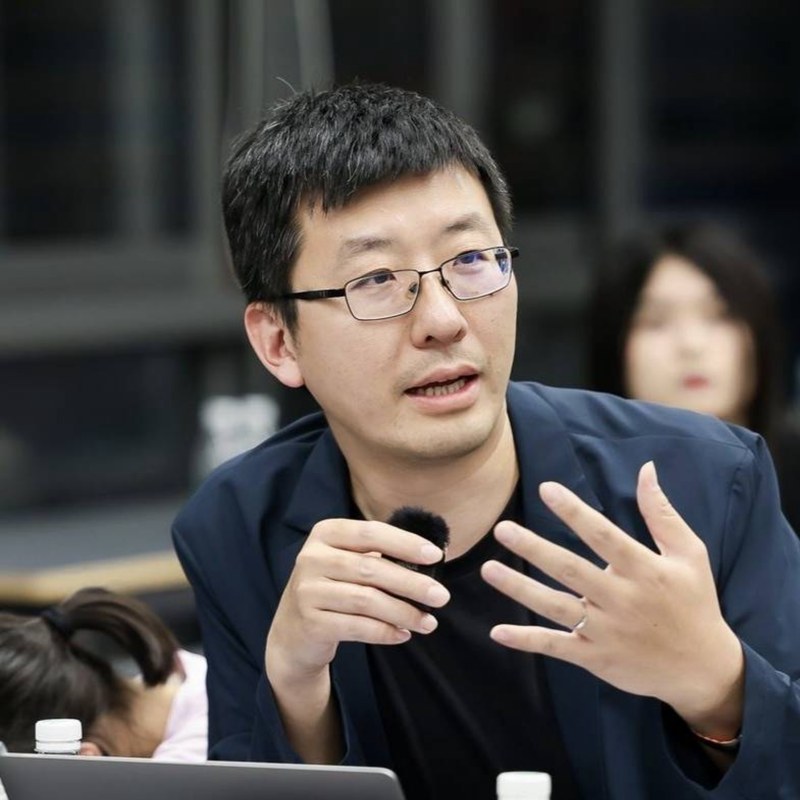
The Living Organization book cover — The New Operating Model for Flourishing in the AI-Native Era by Chunfeng 'Breeze' Dong and Peng Wang. A living wave of blue and gold particles rising from a deep night background.
New Book · 2026 · Chunfeng "Breeze" Dong & Peng Wang

The Living Organization

The New Operating Model for Flourishing in the AI-Native Era

We are deciding, in a narrow window, what work will feel like for a generation. This book is about making that choice consciously — evolving the organization from a machine that manages people into a living system where humans and AI both flourish.

Paperback · Kindle e-book · audiobook — all available now

Chunfeng 'Breeze' Dong, co-author of The Living Organization
Chunfeng "Breeze" Dong Founder, Springbreeze Ventures · ICF PCC
Peng Wang, co-author of The Living Organization
Peng Wang Complex-systems researcher, Tsinghua · 未来博士wepon
The Gap You Can Feel

Exponential technology.
Linear organizations.

A new species of company is compounding while the rest of us hold alignment meetings. The pattern repeats across the industry: tiny teams producing what once took thousands.

$200M ARR
Sierra — from $26M in under two years, serving much of the Fortune 50, with just 165 people
~$5M
revenue per employee at Midjourney — half a billion in revenue from a team that started with 11
3 layers
your idea climbs the hierarchy — and comes back down unchanged, months later, meaning quietly drained

Now picture the organization you actually work in. The committees. The quarterly plan that was obsolete the week it was laminated. The talented people quietly waiting for permission. It is the sensation of a system working hard and moving slowly — of effort that does not convert into motion.

It is not only that our organizations are slow. It is that their slowness quietly drains the people inside them of the conviction that what they do matters.

That feeling has a name in this book. It is the gap — the widening distance between what technology makes possible and what our organizations, designed for a different century, can actually absorb.

Not Another AI Book

You already adopted AI.
That was never the question.

“A jet engine strapped to a horse-drawn carriage — and everyone is surprised when the carriage shakes itself apart.”

Nearly every organization on earth has bought the tools — and bolted them onto an operating model designed for a different century.

The real question is not how do we use AI? but what must our organization become so that AI's potential is actually released?

Drawing on a century of living-systems thinking — and the one thing that has finally changed to make it buildable at scale — this book lays out the AI-Enabled Living System, pillar by pillar. The dream is old. The enabler is new. The choice is yours.

The AI-Enabled Living System

Five pillars of the new operating model

Four pillars have deep roots in a century of organizational pioneering. The fifth has no precedent — and changes everything about the other four.

Pillar One

Distributed Authority

Decisions move to the edge, where the work meets the world — so ideas stop dying from diffusion and start converting into motion.

Pillar Two

Fluid Structure

Teams form around problems, not org charts. Structure becomes something the organization does, not something it has.

Pillar Three

Evolutionary Purpose

A shared "why" strong enough to coordinate a thousand decisions without dictating any of them.

Pillar Four

Human Wholeness

Whole human beings, developed enough to exercise the judgment that distributed decisions require — not roles waiting for permission.

Pillar Five · No Precedent

Human–Agent Governance

The Machine Governance Matrix: how leadership teams govern fleets of digital agents — AI carrying the load, humans carrying the meaning.

"Design the machine to be AI-first, so that the people can be more human."

What's Inside

From argument to playbook

Ten chapters move from the adaptation gap and the machine we inherited, through the fork in the road every leadership team now faces, to the living alternative — and end with a practical playbook, case studies of the frontier in the wild in software and in the physical world of atoms, and a closing chapter on getting from demo to production: forward deployment and the two-way distillation. Evidence is drawn from both Western and Chinese practice, reported from inside each.

The Adaptation Gap Assessment

Locate where exponential technology is outpacing your linear organization — before the gap becomes a crisis.

The Cultural Carriers Method

Grow living networks inside heavy, regulated organizations — proven across a 13,000-person global enterprise.

The Machine Governance Matrix

A leadership-grade framework for deciding what your AI agents may do alone, with review, or not at all.

“Technology removed the constraint.
Philosophy decides the outcome.

— The Living Organization

About the Authors

Two vantage points on the same shift

Chunfeng 'Breeze' Dong — organizational designer, executive coach, and co-author of The Living Organization

Chunfeng "Breeze" Dong

Architect of the AI-Enabled Living System

Breeze is a bridge-builder between two worlds that rarely meet: the metric-driven boardroom and the quieter realm of the human spirit. Trained as an engineer at Beihang University and the University of Cambridge, and certified in the United Kingdom in human-resource management and psychology, she is an ICF Professional Certified Coach (PCC) and a licensed counselor — a combination that lets her help leaders answer the real question of the AI era: not how to adopt the technology, but what an organization must become for its potential to be realized.

For over two decades, Breeze has led people and enterprise-wide transformation inside Fortune 100 companies as an Enterprise Coach and leadership-development partner — including a 13,000-person global pharmaceutical enterprise across nearly 90 countries, where her work was recognized as being at the leading edge of how work actually gets done.

She is the architect of the AI-Enabled Living System, the framework at the heart of this book. Alongside her work in AI-native organization design and Agile, she is a committed meditator who has studied contemplative practice in Bhutan and Nepal. Her conviction distills into one line: design the machine to be AI-first, so the people can be more human.

As founder of Springbreeze Ventures, Breeze helps professionals and organizations move from processing like machines to presencing as whole human beings.

AI-Native Org Design ICF PCC Coach Licensed Counselor Enterprise Transformation Agile Contemplative Practice
www.springbreezeventures.com →
Peng Wang — complex-systems researcher, Professor-level Senior Urban Planner, and co-author of The Living Organization

Peng Wang

Complex systems · Lead author, Chapter 10

Peng Wang is a researcher of complex systems who has spent his career studying how intelligent technology reshapes the environments people live and work in. Educated at Tsinghua University — China's foremost school of engineering — through bachelor's, master's, and now doctoral research in its Engineering Doctorate program for Innovation Leadership, he is a Professor-level Senior Urban Planner.

His work sits at the intersection of artificial intelligence, complexity science, and urban systems: how intelligent technologies actually diffuse through organizations, infrastructures, and cities — and what they demand of the institutions that adopt them. That research has been stress-tested in practice. His career spans top-tier institutions across urban planning, real estate, and technology, giving him a builder's view of the systems he studies — from master plans to data platforms.

As Future Doctor wepon (未来博士wepon), followed by more than 400,000 readers across Chinese platforms, he has become one of China's most trusted public interpreters of AI: a rare voice equally at home in the research literature and the boardroom, reporting on the AI transformation from inside the country where much of it is being built.

For this book, he led the Chinese revision and grounded its arguments in Chinese case studies. He is the lead author of Chapter 10 — From Demo to Production, on forward deployment and the two-way distillation.

Complexity Science Tsinghua University Senior Urban Planner AI Diffusion China Case Studies 400K+ Readers
Questions

What leaders ask about AI-native organization design

What is an AI-native organization?

An AI-native organization is one whose operating model — how decisions are made, how work is structured, how performance is judged — was designed on the assumption that machine intelligence carries part of the load. It is not a company that bought AI tools. The distinguishing test is whether AI changed the org chart and the decision rights, or only the software licences.

What is the AI-Enabled Living System?

The operating model proposed in this book: an organization designed as a living system rather than an efficient machine, in which AI absorbs coordination and processing while humans hold judgement, meaning and direction. Its guiding line is: design the machine to be AI-first, so that the people can be more human.

What are the five pillars?

Distributed Authority, Fluid Structure, Evolutionary Purpose, Human Wholeness, and Human–Agent Governance. The first four adapt principles that self-managing and Teal organizations have long argued for. The fifth is new and has no precedent.

What is human–agent governance?

The discipline of deciding and enforcing what AI agents may do autonomously, what requires human review, and what stays human-only. The Machine Governance Matrix gives leadership teams a way to make those calls deliberately: AI carries the load, humans carry the meaning.

What is the adaptation gap?

The widening distance between exponential technological capability and the linear organization trying to absorb it — a jet engine strapped to a horse-drawn carriage. The Adaptation Gap Assessment helps leadership teams locate where that gap is widest in their own organization before it becomes a crisis.

Why do most enterprise AI transformations stall?

Because the binding constraint is organizational, not technical. Microsoft's 2026 Work Trend Index found 67% of AI adoption barriers are organizational rather than individual: approval layers, data access, incentives, unclear decision rights. Buying better models does not move any of those.

How is this different from Teal and Reinventing Organizations?

Teal argued for distributed authority for years, but most organizations could not afford it: coordination was expensive and hierarchy was the cheapest way to move information. AI removes that constraint, so the preconditions are finally met — and adds the question Teal never had to answer: how do you govern non-human agents?

Who is the book for?

Executives, heads of transformation, HR and organizational development leaders, and anyone accountable for making AI work at enterprise scale. Evidence is drawn from both Western and Chinese practice — including Haier's Rendanheyi, Block's AI-native experiment and Tencent's WorkBuddy team — reported from inside each.

Also by Breeze Dong

A Soulful Transition

Finding Heart-Led Career in the Age of AI — the companion guide for you, while The Living Organization is the guide for your organization. Two guides for the same threshold.

Explore A Soulful Transition
Get the Book

The machine age is ending.
What we build in its place is still a choice.

We can keep building places that quietly drain the people inside them — or we can design for flourishing, not just efficiency. Let us choose to design for life.

Available now in paperback, Kindle e-book, and audiobook.

ISBN 978-3-99507-030-2 (paperback) · ISBN 978-3-99507-031-9 (e-book)